I'm currently trying to translate something into Elvish, for a potential tattoo (just idea stage right now, don't freak out) and finding the correct translation is getting complicated. Anyone keeping up with me might find the issue interesting, so I thought I'd post my findings here.
This is the website I started with, it's called Parf Edhellen and has lots of resources on Tolkien's languages. It doesn't specify in the Elvish scripts, just English spelling of Elvish words.
In order to figure out what the Elvish word would look like in the Elvish script, I did a Google search and ended up on this website, called Tecendil.com. It actually had an English-to-Elvish translation option built into it, which was cool, but it ended up translating the word differently than Parf Edhellen did. I got really mixed up! Here are my posts in chronological order of me trying to figure out the best translation of "breathe!" into Elvish, and then how to spell it in Elvish script.
The rule for making something imperative (a command) is to add the prefix á to the infinitive form of your verb. I got different translations for "to breathe" from different websites, but they were all pretty similar. This post is about me trying to figure out if it was:
súya-
verb. to breathe
or
þúya-
QUENYA v. to breathe
BTW: My username on the site is "Yúlaldië", which is basically a translation of Ashley, which means "a meadow of ash trees". https://quenya101.com/names/a-names/3/#Ashley
Parf Edhellen | Discussion:
Is this translation correct?
But then I looked for how to put it into Elvish script by going to the Tecendil.com website, and I was further confused. Here was my reply to the thread I'd started, and no one had commented yet...
Parf Edhellen | Discussion:
Is this translation correct?
 Yúlaldië · 0 #267
Now I'm trying to figure out the best spelling/script to use. Online translators are so jenk.
www.tecendil.com This link is what is throwing me off. It shows þúya as the Quenya translation of "breathe", and it's using the 'thorn' symbol instead of an 's'. Why? What's the source? It does look cool like that, but then, I can't find þ translated into Tengwar anywhere else that I've looked. I do think that glyph looks cooler (the red text on the page linked above).
Okay, so.....I found some fine print that says why they use the thorn:
"To indicate that a 's' should be transcribed with súlë 3 instead of silmë 8, use the letter thorn, Þ. For example: Þauron (Sauron, The Abhorred)"
So what's the difference between súlë and silmë? Two kinds of s's. I found an image showing names of letters here: goo.gl
That one shows súlë and not silmë. I'm more familiar with silmë, it's the version of 's' that my friends and I use when writing in Elvish. It's the one we wrote down for 's' on our cheat sheet.
What is the difference between súlë and silmë? Thanks!
7/6/2018, 11:22:27 AM
And then it gets complicated still, but makes more sense. I just started a new thread.
Parf Edhellen | Discussion:
Yúlaldië · 0 #269
I don't know why there are two kinds of s's! What's the difference?
Original post: www.elfdict.com
I am trying to make a tattoo saying "breathe" in Quenya. That website is giving me multiple translations of 'breathe' and 'breath', and it has become even more confusing because its translation of the word "sule" (what I thought was just the name for their 's' character) is actually "breath". So the name for their letter 's' translates to "breath" or "spirit". Like, look at this: www.tecendil.com
"súle": QUENYA n. column, pillar
"þúle": QUENYA n. breath; spirit [stem: súli-]
"þúlë": QUENYA n. spirit [as exertion of will]; breath [stem: súli-]
So there's so much of a difference between the word "súle" and the word "þúle" that they are pronounced differently and need a separate character to differentiate between them so that they're not homophones?
But that's not the word that means just "breathe". It's a word I accidentally found by typing "sule" (the word for that 's') instead of "suya" (the word I found for "breathe"). That's getting off-topic.
However, this Tecendil website uses the súle form of 's' (represented by 'þ') to translate the word "to breathe" as "þúya". www.tecendil.com
So is it súya or þúya?
According to www.elfdict.com: "þúya", when entered into the search bar, doesn't match anything on Parf Edhellen.
According to www.tecendil.com: "suya", when entered into the search bar on Tecendil, is recognized and changed to "þúya", as if to say that the only way to write the sound "suya", meaning breathe, is to use the thorn (þ) representing the súle form of 's'.
I just want to know how the word "to breathe" is translated (I know it's "suya") and then how it is to be spelled, in Quenya script, so that I can tattoo it on my wrist to help me remember to breathe when I'm obsessing over details so much that I forget to take good, deep breaths.
7/6/2018, 11:50:11 AM
Parf Edhellen | Discussion:
What is the difference between súlë and silmë?
Yúlaldië · 0 #269I don't know why there are two kinds of s's! What's the difference?
Original post: www.elfdict.com
Súlë and Silmë
www.tecendil.com This website is where I got the súlë from, (represented in English with the letter thorn 'þ').I am trying to make a tattoo saying "breathe" in Quenya. That website is giving me multiple translations of 'breathe' and 'breath', and it has become even more confusing because its translation of the word "sule" (what I thought was just the name for their 's' character) is actually "breath". So the name for their letter 's' translates to "breath" or "spirit". Like, look at this: www.tecendil.com
Breath
Here's a copy and paste of that page:"súle": QUENYA n. column, pillar
"þúle": QUENYA n. breath; spirit [stem: súli-]
"þúlë": QUENYA n. spirit [as exertion of will]; breath [stem: súli-]
So there's so much of a difference between the word "súle" and the word "þúle" that they are pronounced differently and need a separate character to differentiate between them so that they're not homophones?
But that's not the word that means just "breathe". It's a word I accidentally found by typing "sule" (the word for that 's') instead of "suya" (the word I found for "breathe"). That's getting off-topic.
To Breathe
Parf Edhellen translates "breathe" as súya. www.elfdict.comHowever, this Tecendil website uses the súle form of 's' (represented by 'þ') to translate the word "to breathe" as "þúya". www.tecendil.com
So is it súya or þúya?
According to www.elfdict.com: "þúya", when entered into the search bar, doesn't match anything on Parf Edhellen.
According to www.tecendil.com: "suya", when entered into the search bar on Tecendil, is recognized and changed to "þúya", as if to say that the only way to write the sound "suya", meaning breathe, is to use the thorn (þ) representing the súle form of 's'.
What Now?
This is getting deep into phonetics and linguistics, and it's making me wish I could go back to school to get a linguistics degree, the way I wanted to when I was 14 and wanted to develop writing systems for unwritten tribal languages so that the Bible could be translated into their mother tongue...I just want to know how the word "to breathe" is translated (I know it's "suya") and then how it is to be spelled, in Quenya script, so that I can tattoo it on my wrist to help me remember to breathe when I'm obsessing over details so much that I forget to take good, deep breaths.
7/6/2018, 11:50:11 AM
In The End
All my sources show "suya" pronounced "thuya" as a viable translation for "breathe". This is what they look like in the Elvish script (called Tengwar). These images came from https://www.tecendil.com/, and I don't know if it's really the best site to trust... I want it to be accurate! |
| Breathe: "suya" |
 |
| Breathe: þúya |
 |
| Breathe: thuya |
I feel like it's settled, but then there's the issue of the letters: the 's' versus 'þ' versus 'th'.
I'm ruling out 's', so 'suya' which is visually:

So that leaves me with either this or this:
 or
or
Note: You can skip to the red line if it's getting too long.
I can't find the symbol that Tecendil.com says represents the thorn letter (þ). This image shows what the appendix in the back of The Return of the King shows as the Quenya tengwar, and it's an original Tolkien drawing.

There's two versions of 's' in this image! Then there's two ways to write 'ss'. I wish I had my copy of The Return of the King, because I want to see the page from the book for myself...
Here's another one:
https://pin.it/vumvakayobp2sk (full image)

The original image had a bunch of extra stuff. THIS one actually tells you the names of the letters--and ooh, what's that up there under Additional letters, first one on the second row? Silme. Oh, and there's silme reversed, and ss and ss again... So I'm guessing it shares its source with that previous image with 4 s's.
There's also the th/s translated as "thule/sule" up there, first one on the third row. Either one is correct, I'm guessing, but man... How do I know which one to use? Which is correct? Aggghhhh why is this so hard?!
Back to the Basics
I need to remind myself of what I really need right now. I'll start with listing the points I've established:
Things I know for sure:
- To make a word imperative (a command), you use the infinitive form of the verb ("to breathe") and add the imperative prefix.
á þúya - That looks like this, according to Tecendil.com:
-

á þúyaSo, what's the difference between that and what my best sources say is the way to write it?
————————————————————

Then, with the 'ú':

So here we have another mystery... Why does the pronunciation dash (actually, Wikipedia says it's called an Acute Accent...) Why does the acute accent above the 'u' add that extra placeholder (the vertical stroke connected to the súle/thúle letter)?
Somewhere, someone decided to make it look that way... Would it be spelled that way in Elvish? I feel like, if pronouncing it "þuya" rather than "þúya" gave it a different meaning, that would mean that "þuya" would have a definition of its own that differed from "þúya". Let's test this.
Is "þúya" different from "þuya"?
I don't know. I'm asking a question now in the thread.
Someone replied!!! Here's what they said to my second thread.
Parf Edhellen | Discussion:
What is the difference between súlë and silmë?

Elaran · 0 #271
I recommend reading this Tolkien Gateway article: The case of the Quenya change of þ > s.
In short, the Ñoldor, or at least those who disliked Fëanáro, changed the sound "þ" to "s" in their speech, although they still used the tengwa for "þ" in writing (but not for the words that always had "s"). Apart from Fëanáro and his supporters, Ñoldorin linguists continued to use "þ" as well, regardless of their feelings about Fëanáro. This should help with your decision on how to pronounce "þ/s", but remember the distinction while writing in Tengwar.
7/6/2018, 1:43:18 PM
So this is what I said:
Yúlaldië · 0 #272
Thank you for your reply!
How interesting. So it's a colloquialism, kind of like how some Spanish speakers change 'y' to 'j' (calling the color yellow "jello") because of that one king with a lisp way back in the day. That might be a myth, or I'm remembering the story wrong. Anyway.
So what you're saying is, some people would pronounce the translation of "breathe" as "thuya", if they were supporters of Fëanor, and some would pronounce it as "suya" if they disliked Fëanor. So I have to decide if I like Fëanor or not, and then decide how to pronounce the word when I tell people about my tattoo?
You say they changed "þ" to "s", but not for words that always had "s". How can I tell if this word súya/þúya always had "s" or if it was originally "þ"? One website (Tecendil.com) says it's definitely "þ", but Parf Edhellen uses "s" saying it is pronounced "th".
Another spelling question now, pertaining to Tengwar that I got from Tecendil.com. Visually, that website spells "þúya" differently if I use the acute accent over the 'u' or not (þúya v. þuya). It places the 'ú' over a placeholder stroke (like you do for a freestanding vowel with no consonants to hang onto), instead of putting the 'u' over the "þ".
I just need to know 1) if it's the súlë or silmë character, for when I get the tattoo, 2) if it's pronounced "s" or "th", for when I tell people what my tattoo says, and 3) whether the 'ú' creating a placeholder within the spelling, for an accent, is correct or not.
Thank you!
7/6/2018, 2:29:55 PM
|
| þuya |
|
| þúya |
As I am mainly wanting to pair a tattoo of 'breathe' with a matching tattoo of 'pray', I should consider what 'pray' will look like. The phrase would be á arca, matched with á þúya. Here is 'pray':
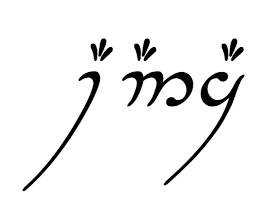 |
| á arca |
So that, next to á þúya, looks like this:
 |
| á arca, á þúya |
If it was á arca, á þuya, where there was no acute accent over the u in 'þúya', it would look like this:
 |
| á arca, á þuya |
There are a lot of options here...I could say 'breathe' on one hand and 'pray' on the other, or I could say 'breathe' on one and 'and pray' on the other.
Apparently, the word for 'and' in Quenya is 'a' (different from the word making it imperative, which is 'á'. So that makes 'breathe and pray' look like this:
 |
| á arca a þúya |
Or like this:
 |
| á arca a þuya |
So, do I want to have two long downward strokes on my left hand, and no long downward strokes on my right, as in this last image? Or would I prefer á arca, á þúya, which has two long downward strokes on the left and the right hand, from á and ú?
It's finally come down to making pictures of what it would look like on my hands. I'm going to make a new post, and I'll ask you to vote on which one you prefer.

